
When Should You Consult an IVF Specialist? A Guide for Couples in Jharkhand

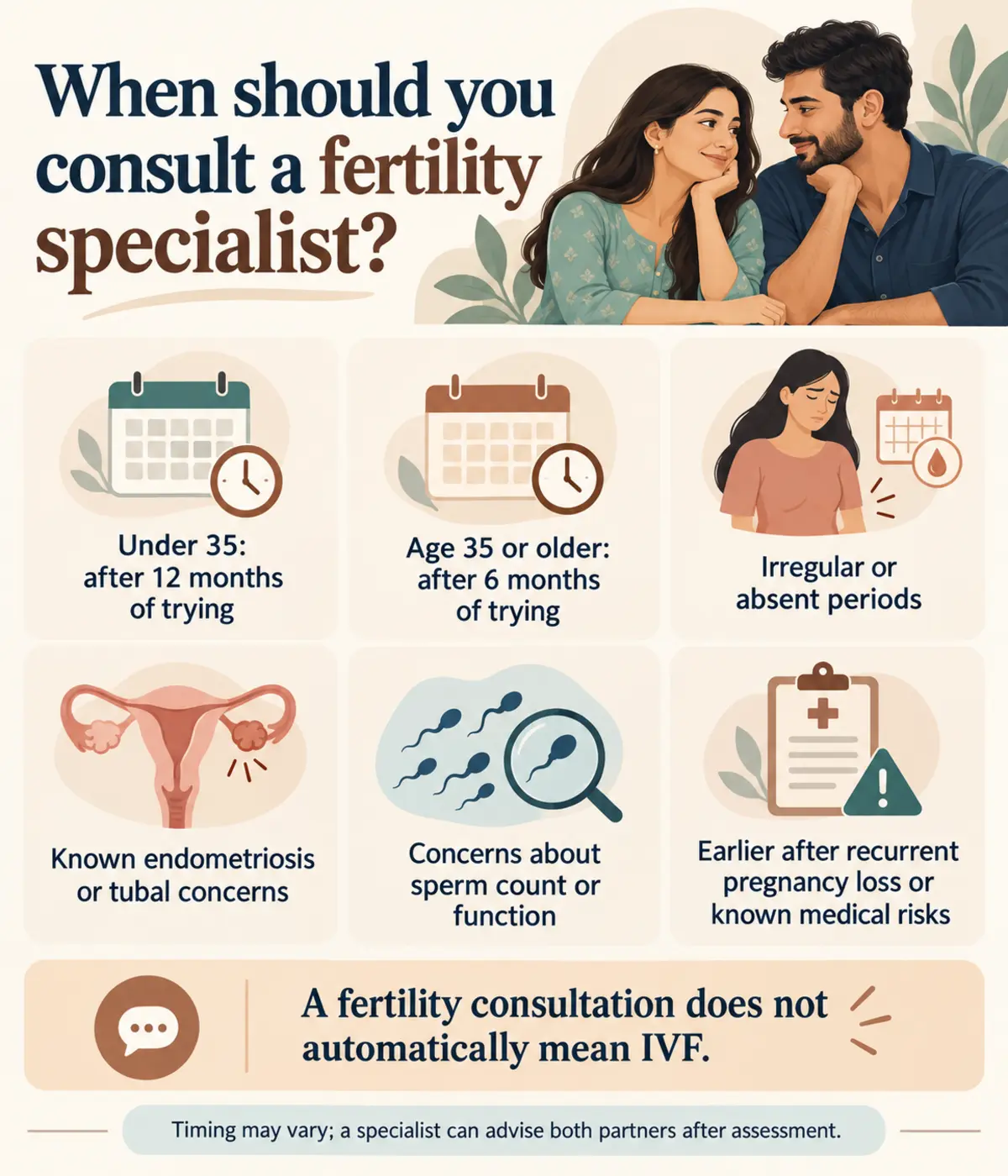
Quick answer: If the female partner is under 35, fertility evaluation is generally considered after 12 months of regular unprotected intercourse without pregnancy. If she is 35 or older, evaluation may be considered after six months. Women over 40 and couples with a known reproductive concern should seek advice sooner.
Consulting a fertility or IVF specialist does not mean that IVF will automatically be advised. The first step is understanding whether a fertility problem exists, whether it involves the female partner, male partner, both partners or remains unexplained after evaluation.
What is infertility?
The World Health Organization defines infertility as a condition of the male or female reproductive system involving failure to achieve pregnancy after 12 months or more of regular unprotected sexual intercourse.
Infertility may be:
- Primary infertility: Pregnancy has not occurred previously.
- Secondary infertility: Difficulty conceiving after a previous pregnancy.
- Female-factor infertility: A female reproductive factor is identified.
- Male-factor infertility: A male reproductive factor is identified.
- Combined infertility: Factors involving both partners are found.
- Unexplained infertility: Standard evaluation does not identify a definite cause.
Infertility is not automatically “the woman's problem.” Fertility concerns can involve either partner, which is why both partners should participate in evaluation whenever applicable.
When should a couple seek fertility advice?
A commonly used timeline is:
These are general recommendations, not rigid rules. Individual medical, reproductive and sexual history can justify earlier assessment.
When should you consult earlier?
Do not necessarily wait for six or twelve months if either partner has a known concern that may affect fertility.
Reasons for earlier female fertility evaluation
Consider earlier consultation in cases of:
- Irregular, very infrequent or absent periods
- Very painful periods
- Suspected or diagnosed endometriosis
- Polycystic ovary syndrome
- Fibroids affecting the uterine cavity
- Previous pelvic inflammatory disease
- Previous ectopic pregnancy
- Known or suspected blocked fallopian tubes
- Previous ovarian, pelvic or abdominal surgery
- Repeated pregnancy loss
- Premature ovarian insufficiency
- Previous chemotherapy or radiotherapy
- Known genetic or hormonal condition
- Difficulty with intercourse
- Age-related fertility concerns
Reasons for earlier male fertility evaluation
Earlier assessment may be appropriate when there is:
- Previous abnormal semen analysis
- Testicular injury, surgery or infection
- Undescended testis
- Difficulty with erection or ejaculation
- Very low sexual desire
- Previous chemotherapy or radiotherapy
- Known hormonal or genetic condition
- Use of medicines or hormones that may affect sperm production
- Previous sterilisation or reproductive surgery
A consultation does not confirm infertility. It helps determine whether evaluation is appropriate.
Does consulting an IVF specialist mean IVF is necessary?
No. An IVF specialist or fertility clinician evaluates the cause of difficulty conceiving and explains the available options. IVF is only one possible treatment.
Depending on the findings, the plan may involve:
- Education about the fertile window
- Timed intercourse
- Lifestyle and medical optimisation
- Treatment of thyroid, hormonal or metabolic concerns
- Ovulation-induction medicines
- Treatment of an infection when present
- Surgery for selected gynaecological conditions
- Intrauterine insemination
- In-vitro fertilisation
- Intracytoplasmic sperm injection
- Use of donor gametes where appropriate and legally permitted
- Fertility preservation
- Counselling or additional specialist referral
Some couples may conceive naturally after receiving appropriate advice or treatment. Others may require assisted reproductive treatment. No responsible clinic should promise pregnancy or recommend IVF before reviewing the couple's individual situation.
Why should both partners be evaluated?
Pregnancy depends on several steps involving both partners. Evaluation may consider:
- Ovulation
- Ovarian reserve
- Uterus and uterine cavity
- Fallopian-tube patency
- Sperm count, movement and form
- Sexual and reproductive history
- General health and medicines
- Timing and frequency of intercourse
The American Society for Reproductive Medicine and male-infertility guidance emphasise concurrent evaluation of the male partner when appropriate. Testing only the female partner can delay diagnosis when a male factor or combined factor is present. The process should remain respectful, private and free from blame.
What happens during the first fertility consultation?
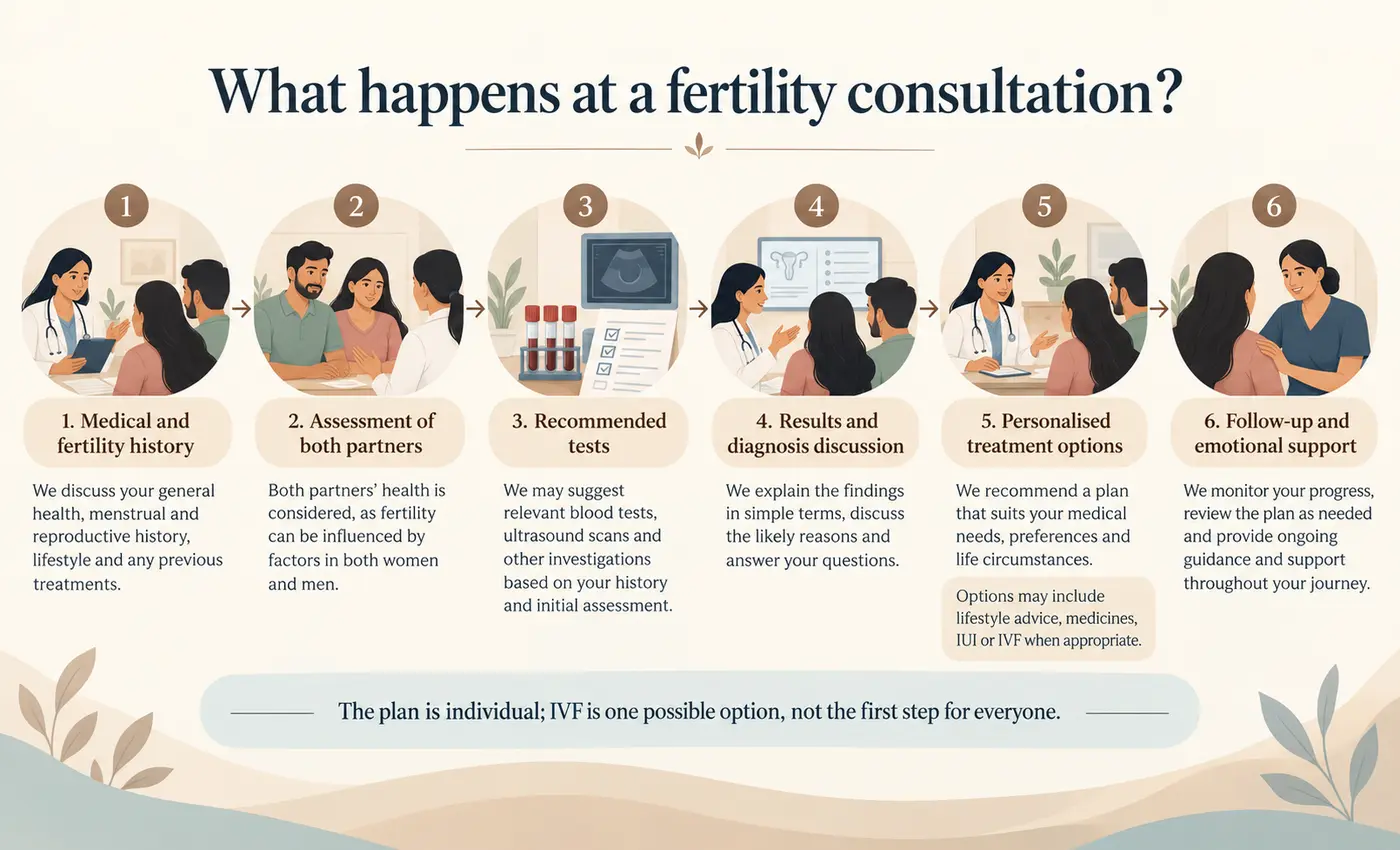
The first appointment usually focuses on understanding the couple's history. The specialist may ask about:
- How long the couple has been trying
- Frequency and timing of intercourse
- Previous pregnancies
- Miscarriages or ectopic pregnancy
- Menstrual-cycle length and regularity
- Pelvic pain or painful intercourse
- Previous infections
- Medical conditions and operations
- Current medicines and supplements
- Contraception previously used
- Lifestyle, tobacco and alcohol
- Family history
- Previous fertility tests or treatment
- Male reproductive and sexual history
Some questions may feel personal. Honest information helps the clinician choose relevant investigations and avoid unnecessary tests. Couples should bring previous prescriptions, ultrasound reports, laboratory results, operative records and earlier fertility-treatment documents.
Which fertility tests may be advised for women?
Tests are selected according to age, history and clinical findings. Not every patient needs every test. Possible assessment may include:
Ovulation and menstrual evaluation
The doctor may review menstrual history or advise hormonal testing to assess whether ovulation is occurring regularly.
Pelvic ultrasound
Ultrasound may assess:
- Uterus
- Endometrium
- Ovaries
- Follicles
- Fibroids
- Ovarian cysts
- Features associated with PCOS
- Other pelvic findings
Ovarian-reserve assessment
Tests such as AMH and ultrasound follicle assessment may be considered in selected patients. These tests must be interpreted in context and cannot independently guarantee or rule out pregnancy.
Fallopian-tube assessment
The clinician may advise an appropriate test to determine whether the fallopian tubes appear open. The chosen test depends on the medical history and available findings.
Additional tests
Thyroid, prolactin or other tests may be advised when clinically relevant.
Which tests may be advised for men?
Semen analysis is commonly an important early investigation. It may assess:
- Semen volume
- Sperm concentration
- Sperm movement
- Sperm shape
- Other laboratory characteristics
An abnormal result may need to be repeated because semen parameters can vary. Depending on the findings, the male partner may require:
- Medical examination
- Hormonal tests
- Ultrasound
- Genetic testing
- Infection assessment
- Referral to an andrologist or urologist
A single report should be interpreted by a qualified clinician rather than through an online comparison alone.
What is IVF?
IVF means in-vitro fertilisation. In a typical IVF process:
- Medicines stimulate the ovaries to develop multiple follicles.
- The response is monitored using ultrasound and, when required, blood tests.
- Eggs are collected through a planned procedure.
- Eggs and sperm are handled in the embryology laboratory.
- Fertilisation and embryo development are monitored.
- A selected embryo may be transferred into the uterus.
- Medicines may be continued as advised.
- A pregnancy test is performed on the date given by the clinical team.
The exact process varies according to the patient, treatment protocol and laboratory plan. IVF does not guarantee pregnancy. Outcomes depend on several factors, including age, ovarian reserve, sperm factors, embryo development, uterine factors, underlying diagnosis and previous reproductive history.
What is ICSI, and is it the same as IVF?
ICSI means intracytoplasmic sperm injection. It is a laboratory technique in which a selected sperm is injected into an egg. It may be considered in selected male-factor cases or other clinical situations.
ICSI is performed as part of an IVF treatment cycle. It is not automatically necessary for every IVF patient. The fertility team should explain why conventional IVF or ICSI is being considered.
Can PCOS cause infertility?
PCOS can affect ovulation and menstrual regularity, making conception more difficult for some women. However, having PCOS does not mean pregnancy is impossible or that IVF will automatically be required. Treatment depends on:
- Age
- Menstrual pattern
- Ovulation
- Weight and metabolic health
- Fallopian-tube status
- Semen analysis
- Duration of infertility
- Previous treatment
Some patients may respond to lifestyle measures or ovulation treatment, while others may need more advanced care.
Can fibroids or endometriosis affect fertility?
Some fibroids can affect fertility depending on their size and location, particularly if they distort the uterine cavity. Endometriosis may affect fertility through inflammation, adhesions, ovarian involvement or altered pelvic anatomy.
Not every fibroid requires surgery, and not every patient with endometriosis requires IVF. Treatment should consider symptoms, age, ovarian reserve, fertility goals and previous treatment. Patients can learn more about fibroid treatment in Ranchi and laparoscopic gynaecology at Hopewell Hospital. If keyhole surgery is being considered, read which operations may be performed laparoscopically.
What if a couple has conceived before but cannot conceive again?
This is called secondary infertility. Possible factors include:
- Changes associated with age
- New ovulation problems
- Reduced ovarian reserve
- Fibroids or endometriosis
- Tubal damage
- Changes in sperm parameters
- Medical illness or medicines
- Complications after a previous pregnancy
- Unexplained factors
A previous pregnancy does not rule out a current fertility problem. Both partners may still require evaluation.
What role does age play in fertility?
Female fertility generally declines with age, with a more noticeable decline after the mid-thirties. This is one reason evaluation is recommended earlier when the female partner is 35 or above.
Male fertility can also change with age, health, medicines and lifestyle. Age should be discussed honestly but sensitively. It should guide timely evaluation, not create panic or pressure couples into treatment without adequate counselling.
Can lifestyle changes improve fertility?
General health can support reproductive health, but lifestyle changes cannot correct every cause of infertility. Helpful measures may include:
- Avoiding tobacco
- Limiting or avoiding alcohol as medically advised
- Maintaining a healthy weight
- Managing diabetes, thyroid disease and hypertension
- Regular moderate activity
- Adequate sleep
- Reviewing medicines with a doctor
- Avoiding non-prescribed hormonal or fertility products
- Taking folic acid when advised
- Protecting against sexually transmitted infections
Couples should be cautious about supplements or therapies promising guaranteed pregnancy.
How should couples compare IVF centres?
Consider more than advertisements and package prices. Ask about:
- Qualifications and roles of the treating team
- Whether both partners are evaluated
- Tests included in the assessment
- Why IVF or ICSI is being advised
- Alternative treatment options
- Embryology laboratory processes
- Medicine and monitoring requirements
- Number of visits expected
- Financial inclusions and exclusions
- Consent and counselling
- Privacy and record handling
- Emergency contact arrangements
- Follow-up after treatment
- Legal and regulatory compliance
No centre can ethically guarantee pregnancy or a baby.
What does fertility treatment cost in Ranchi?
There is no single price for every patient because infertility treatment is not one standard package. The cost may depend on:
- Initial consultations
- Investigations for both partners
- Ultrasound monitoring
- Medicines and injections
- IUI, IVF or ICSI
- Egg-retrieval procedure
- Anaesthesia
- Embryology laboratory services
- Embryo freezing or storage
- Additional clinically indicated procedures
- Number of treatment cycles
Before treatment, request a written estimate describing inclusions, exclusions, medicine costs, storage charges and possible additional expenses. A low advertised starting price may not represent the complete treatment cost.
Fertility and women's healthcare at Hopewell Hospital, Ranchi
Hopewell Hospital, Ranchi provides fertility, gynaecology and women's-health consultations led by Dr Neha Ali — IVF, Gynaecology & Women's Health. The care pathway may include:
- Couple-based fertility consultation
- Menstrual and ovulation assessment
- Ultrasound evaluation
- Relevant female and male investigations
- Review of PCOS, fibroids and endometriosis
- Infertility counselling
- Discussion of available treatment options
- Laparoscopic gynaecology when clinically indicated
- IVF-related evaluation and planning
- Follow-up and pregnancy care
Learn more about infertility treatment at Hopewell Hospital. Couples travelling from Hazaribagh, Ramgarh, Bokaro, Gumla, Lohardaga or elsewhere in Jharkhand should confirm the appointment schedule and reports required before travelling. To begin with a confidential consultation, contact Hopewell Hospital for an IVF and fertility appointment.
Final answer: When should you consult an IVF specialist?
Consider fertility evaluation:
- After 12 months when the female partner is under 35
- After six months when she is 35 or above
- More immediately when she is over 40
- Earlier when either partner has a known reproductive concern
- Earlier for irregular periods, endometriosis, PCOS, tubal concerns, previous ectopic pregnancy, repeated pregnancy loss or known male-factor concerns
Consulting an IVF specialist does not mean IVF is compulsory. It means identifying the possible cause, evaluating both partners and choosing the most appropriate next step.
Have questions about this condition?
Speak with the Hopewell Hospital team for a personalised assessment and treatment plan.
Frequently asked questions
Should we consult an IVF specialist after six months of trying?
If the female partner is 35 or older, evaluation after six months may be appropriate. Below 35, evaluation is generally considered after 12 months unless a known concern exists.
Should both partners attend the first appointment?
Whenever applicable, both partners should participate because fertility concerns may involve either or both partners.
Will the doctor immediately recommend IVF?
Not necessarily. Treatment may include education, timed intercourse, medicines, IUI, surgery, IVF, ICSI or another plan depending on the diagnosis.
Can irregular periods cause difficulty conceiving?
Irregular or absent periods may indicate irregular ovulation or another hormonal concern. They are a reason to consider earlier evaluation.
Can a woman with PCOS become pregnant without IVF?
Many women with PCOS conceive without IVF. The appropriate plan depends on ovulation, age, fallopian tubes, semen analysis and other factors.
Does one abnormal semen report confirm male infertility?
Not always. Semen parameters can vary, and repeat testing or further assessment may be required.
Is IVF guaranteed to work?
No. IVF cannot guarantee pregnancy or a live birth. Outcomes vary according to several biological and clinical factors.
Can couples seek treatment after having one child?
Yes. Difficulty conceiving again is called secondary infertility and may require evaluation.
What documents should we bring?
Bring earlier prescriptions, ultrasound reports, hormone tests, semen reports, operative records, pregnancy records and details of current medicines.
Where can we consult an IVF specialist in Ranchi?
Hopewell Hospital provides IVF, infertility, gynaecology and women's-health consultation in Ranchi. Contact the hospital to confirm Dr Neha Ali's consultation schedule.
Medical disclaimer
This article provides general patient education and does not diagnose infertility or recommend IVF for an individual. Fertility treatment requires confidential consultation and personalised evaluation of relevant partners. Treatment options, risks and expected outcomes must be discussed with qualified medical professionals.