
Knee Arthritis: When Should You Consider Knee Replacement Surgery?

Quick answer: Knee replacement is usually considered when arthritis has become severe, pain and stiffness are substantially affecting daily life, and appropriate non-surgical treatment is no longer providing enough relief. The decision should be based on symptoms, function, examination, X-rays, overall health and the patient's goals — not on age or an X-ray alone.
For people exploring knee arthritis treatment in Ranchi, an orthopaedic consultation can clarify whether continued non-surgical care, an injection, a joint-preserving option, partial knee replacement or total knee replacement is the most appropriate next step.
When may knee replacement be appropriate?
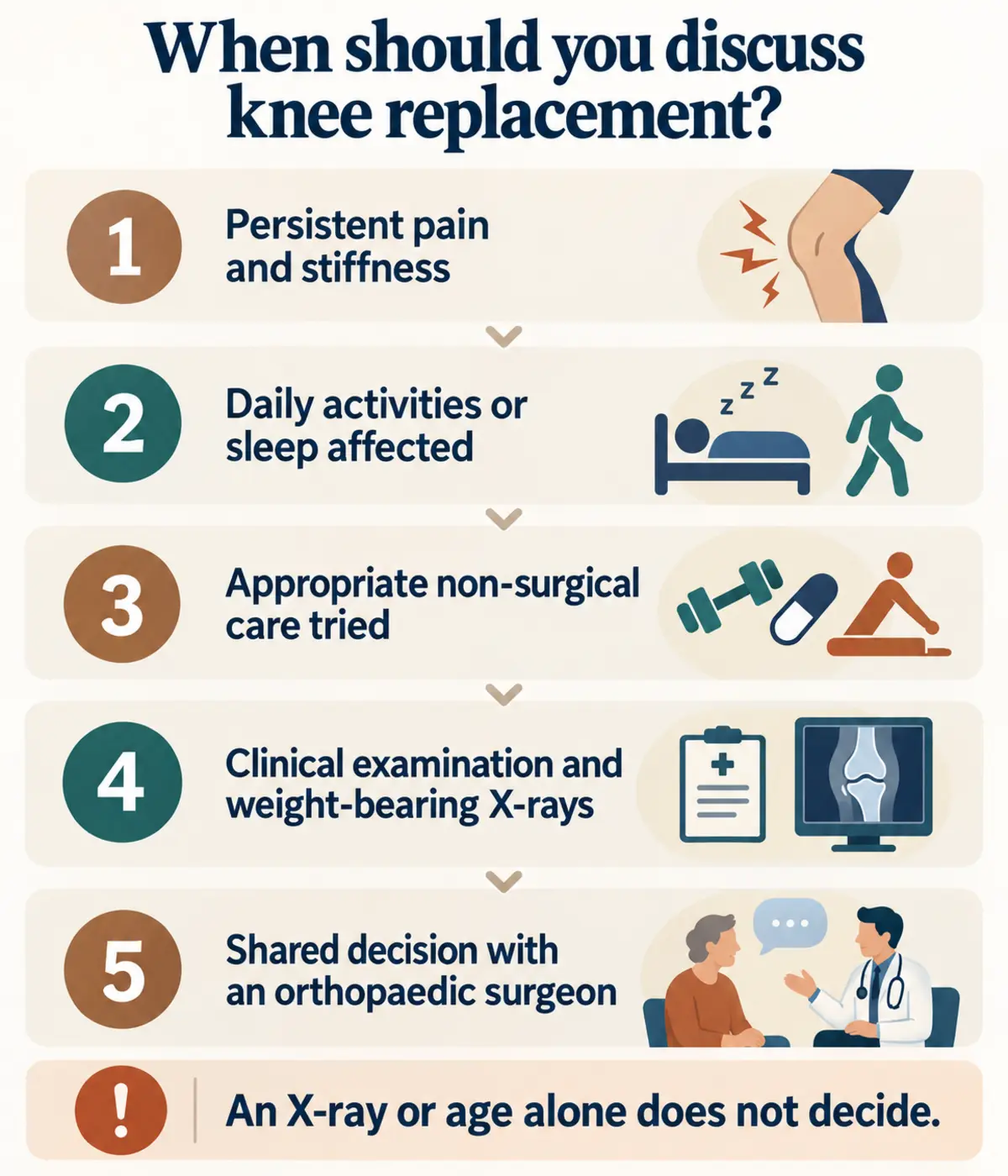
You may be ready to discuss knee replacement surgery in Ranchi when several of the following are present:
- Knee pain is severe or persistent and limits walking, stairs, work or household activities
- Pain occurs at rest or wakes you at night
- Stiffness and reduced movement are affecting independence
- The knee has developed a progressive bow-leg or knock-knee deformity
- X-rays show advanced joint damage that matches your symptoms
- Medicines, activity changes, physiotherapy, weight management or other suitable treatments have not provided adequate relief
- You understand the benefits, limitations, risks and rehabilitation required after surgery
No single symptom confirms the need for an operation. A knee specialist must assess the complete clinical picture and discuss what matters most to the patient.
What is knee arthritis?
Arthritis is a condition in which a joint becomes painful, stiff or inflamed. Osteoarthritis is the most common form affecting the knee. It involves progressive damage to cartilage and other joint structures. As the condition advances, the space between the bones may narrow and movement can become painful.
Other causes of serious knee damage include inflammatory arthritis, previous fractures, ligament injuries, infection-related damage and post-traumatic arthritis. Because knee pain can also arise from the hip, spine, tendons or soft tissues, a correct diagnosis should come before treatment.
Signs that knee arthritis may be becoming advanced
Early knee arthritis may produce discomfort after prolonged walking or activity. More advanced disease may affect mobility, rest and independence.
Symptoms and X-rays do not always progress at the same rate. Some people have marked changes on an X-ray but manageable symptoms; others have substantial pain and disability with less dramatic imaging. Treatment should therefore be personalised.
Does an X-ray decide whether you need knee replacement?
No. Weight-bearing X-rays help the orthopaedic surgeon assess joint-space narrowing, bone changes, alignment and which parts of the knee are affected. However, an X-ray is only one part of the decision.
The surgeon will also consider:
- Where the pain is located and how long it has been present
- How far you can walk and which activities have become difficult
- Whether pain interferes with sleep
- Knee movement, stability, swelling and deformity
- Whether symptoms could be coming from the hip, back or another condition
- Treatments already tried and how you responded
- Medical conditions that may influence surgery or recovery
- Your expectations and willingness to participate in rehabilitation
MRI is not required for every person with established knee osteoarthritis. It may be advised when the diagnosis is uncertain or when the surgeon needs additional information for a particular treatment decision.
What should usually be tried before knee replacement?
Many patients can manage knee arthritis without surgery, particularly in the earlier stages. The treatment plan depends on symptoms, health, lifestyle and the pattern of joint damage.
Exercise and physiotherapy
Appropriate exercise can improve muscle strength, joint movement, balance and confidence. A physiotherapist may recommend quadriceps strengthening, flexibility work, gait training and low-impact activity. Exercises should be selected for the individual rather than copied from an unverified video or social-media post.
Weight management
For a patient who is overweight, gradual and medically appropriate weight reduction may decrease the load on the knee and improve mobility. Weight is only one part of assessment and should not be used to dismiss a patient's symptoms.
Medicines and pain-relief strategies
Pain medicines or anti-inflammatory medicines may be suitable for some patients, but they can have side effects and interactions. A doctor should advise what is safe, especially for people with kidney disease, ulcers, heart disease, blood-pressure problems or those taking blood thinners.
Walking aids and activity modification
A walking stick, supportive footwear, pacing and changes to high-impact activities can reduce strain while helping a person stay active.
Injections
An injection may be considered for selected patients to manage symptoms, but suitability and expected benefit vary. Injections do not rebuild worn cartilage and should not be presented as a guaranteed alternative to surgery. When these measures are appropriate but no longer control pain or preserve acceptable function, it may be reasonable to discuss joint replacement.
When waiting longer may not be helpful
There is no universal deadline for knee replacement. However, repeatedly postponing assessment while severe pain, deformity and immobility worsen can lead to muscle weakness, reduced fitness and greater dependence.
An orthopaedic review is especially useful when:
- Pain continues despite a structured treatment plan
- Walking distance is steadily decreasing
- Sleep is regularly disturbed
- The leg is becoming visibly deformed
- Work, self-care or family responsibilities are becoming difficult
- The patient is relying on frequent medication without satisfactory relief
Consulting a surgeon does not commit a patient to surgery. It creates an opportunity to understand the stage of arthritis and compare the available options.
Total versus partial knee replacement
Knee replacement resurfaces damaged areas of the joint using metal and medical-grade plastic components. The operation may be total or partial.
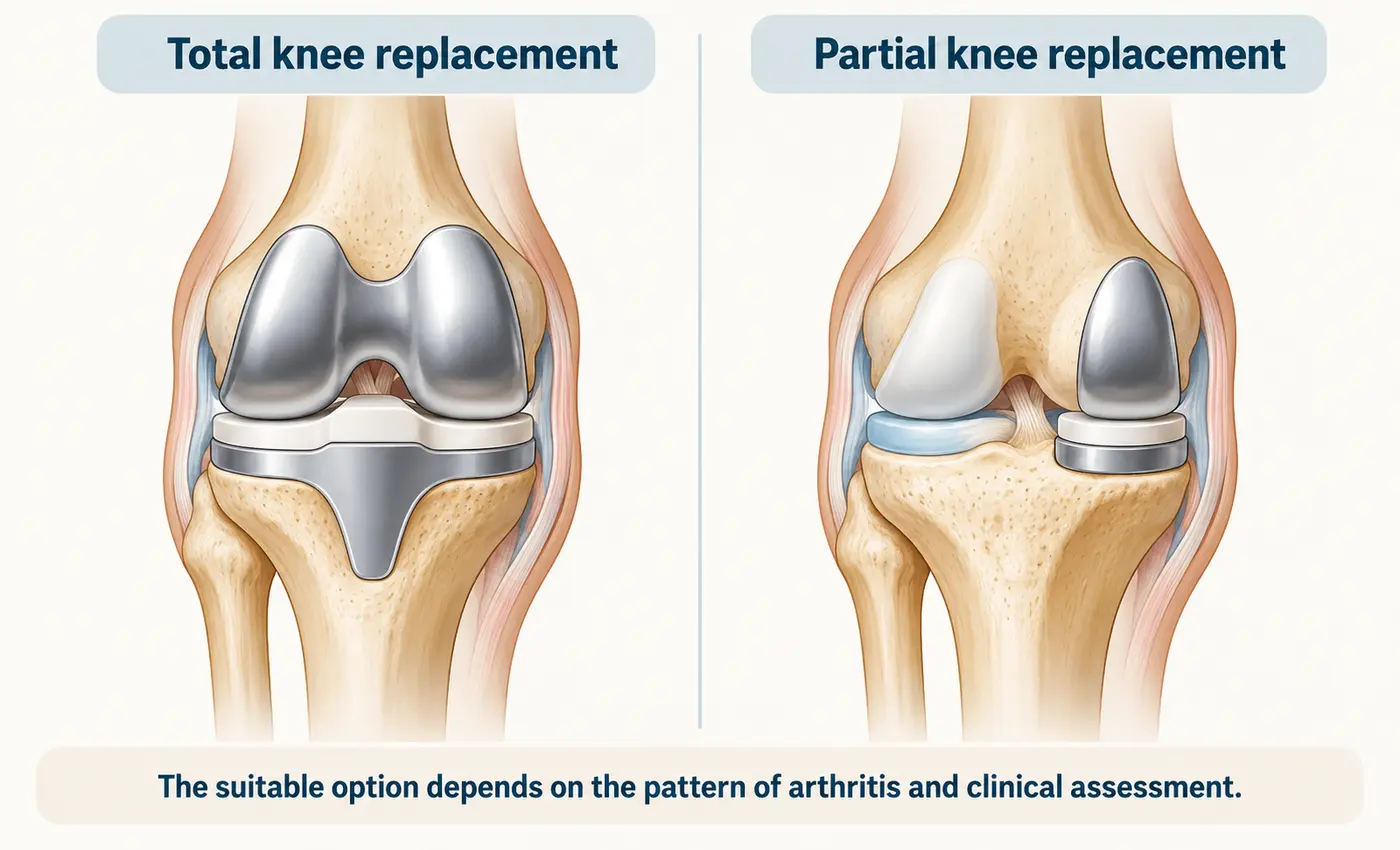
A partial replacement is not automatically better because the incision or procedure may be smaller. The correct option depends on the distribution of arthritis, ligament function, deformity, bone quality and the surgeon's assessment. Learn more on Hopewell's Knee Replacement in Ranchi page.
What happens during a knee-replacement evaluation?
At the first consultation, the orthopaedic specialist will usually take a detailed history, examine the knee and review or order appropriate X-rays. If surgery is being considered, the discussion should cover:
- The diagnosis and whether pain is truly arising from the knee
- Reasonable non-surgical and surgical choices
- Expected pain relief and functional goals
- Total versus partial replacement where relevant
- Implant selection based on clinical need rather than marketing claims
- Anaesthesia, hospital stay and pain-control planning
- Possible complications and how risks are reduced
- Rehabilitation, home support and follow-up
- Likely costs and what is included in the estimate
Patients should bring a list of medicines, previous reports and X-rays, details of allergies and information about existing medical conditions.
Is age the deciding factor?
There is no single age at which every patient should or should not undergo knee replacement. Symptoms, joint damage, overall health, activity needs and the ability to complete rehabilitation are more useful than age alone.
Older adults may need careful assessment of heart, lung, kidney, diabetes and medication-related risks. Younger patients may need a detailed discussion about activity expectations and the possibility that an implant could require revision later in life. The decision should be individual and shared between the patient and the clinical team.
Preparing safely for surgery
If knee replacement is advised, preparation may include blood tests, X-rays, anaesthesia assessment and review of medical conditions. Patients may be asked to improve blood-sugar control, stop tobacco use, address active infections, review blood-thinning medicines, strengthen the leg and prepare the home for safe movement.
Never stop a prescribed medicine — including aspirin or another blood thinner — without instructions from the treating doctor.
Recovery after knee replacement
Recovery is a process, not a single date. Patients are commonly encouraged to begin standing and walking with support early when medically safe. The initial priorities include pain control, safe movement, swelling management, circulation, wound care and prevention of complications.
Over the following weeks, physiotherapy focuses on knee bending and straightening, muscle strength, balance, walking pattern and gradual return to routine activity. Recovery differs according to pre-operative fitness, age, other illnesses, the type of operation and participation in rehabilitation.
Patients should follow their own surgeon's instructions rather than comparing their recovery day by day with another person's experience.
Risks and realistic expectations
Knee replacement can reduce arthritis pain and improve function in appropriately selected patients, but it cannot make every knee feel exactly like a natural, unaffected joint. Possible complications include infection, blood clots, bleeding, stiffness, persistent pain, nerve or blood-vessel injury, fracture, implant wear or loosening, anaesthesia-related problems and future revision surgery.
Before giving consent, a patient should understand personal risk factors, reasonable expected benefits, the recovery commitment and alternatives to surgery. No ethical hospital or surgeon should promise a complication-free operation or a guaranteed outcome.
How to choose a knee replacement hospital in Ranchi
People often search for the “best knee replacement hospital in Ranchi,” but no hospital is the best choice for every person. A safer comparison focuses on transparent, verifiable aspects of care:
- A qualified orthopaedic and joint-replacement team
- Appropriate imaging and pre-operative assessment
- Anaesthesia and medical support for existing health conditions
- Infection-prevention and patient-safety protocols
- Clear implant and cost counselling
- Pain-management and early-mobilisation planning
- Physiotherapy and rehabilitation support
- Emergency and critical-care backup
- Structured follow-up after discharge
Hopewell Hospital's Orthopaedics & Joint Replacement service provides evaluation and coordinated care for arthritis, joint replacement, fractures and sports-related conditions. Its knee-replacement pathway includes clinical assessment, X-ray planning, medical fitness, implant selection, surgery, early mobilisation and physiotherapy support.
Knee replacement consultation at Hopewell Hospital, Ranchi
Hopewell Hospital offers knee replacement care in Ranchi under its Orthopaedics & Joint Replacement service, led by Dr. Ashish Paal. To discuss persistent knee pain, arthritis treatment or whether joint replacement is appropriate, view Hopewell's doctors, book an orthopaedic appointment or contact Hopewell Hospital.
Hopewell Hospital is located at New Hopewell Hospital, Hazari Baug Road, Tharpakna, Ranchi, Jharkhand 834001.
Final answer: when should you consider knee replacement?
Knee replacement is usually appropriate when arthritis is advanced, pain and stiffness substantially affect daily life, and suitable non-surgical treatment no longer provides adequate relief. The decision should combine symptoms, function, examination, X-rays, overall health and the patient's own goals rather than age or imaging alone.
Have questions about this condition?
Speak with the Hopewell Hospital team for a personalised assessment and treatment plan.
Frequently asked questions
Does every person with knee arthritis need surgery?
No. Many people manage symptoms with exercise, physiotherapy, weight management, medicines, activity changes or other appropriate treatments. Surgery is generally discussed when pain and loss of function remain substantial despite suitable non-surgical care.
What is the main sign that it is time to discuss knee replacement?
The most important sign is not an X-ray finding alone. It is persistent knee pain and disability that substantially affect daily life, together with clinical and imaging findings consistent with advanced joint damage.
Can knee replacement help night pain?
Knee replacement may reduce arthritis-related pain, including night pain, in appropriately selected patients. The surgeon must first confirm that the pain is coming from the knee and discuss realistic expectations.
Is total knee replacement always required?
No. Some patients do not need surgery, and selected patients with arthritis limited to one compartment may be candidates for partial knee replacement. The decision depends on examination, X-rays, ligaments, alignment and the location of joint damage.
Can both knees be replaced at the same time?
Simultaneous bilateral knee replacement may be considered in carefully selected patients, but it is not suitable for everyone. The surgeon and anaesthesia team must assess medical fitness, rehabilitation needs and individual risks.
How soon can a patient walk after knee replacement?
Patients are often encouraged to stand and walk with assistance early after surgery when medically safe. The exact timing and level of support vary by patient and clinical protocol.
How long does complete recovery take?
Early mobility begins soon after surgery, but improvement in strength, movement and confidence continues over weeks to months. Recovery varies, so the treating team should provide the patient's specific timeline.
How much does knee replacement cost in Ranchi?
The final cost depends on whether one or both knees are treated, total or partial replacement, implant category, room type, investigations, medicines, anaesthesia, medical conditions, physiotherapy and length of stay. Ask for a written, itemised estimate after clinical evaluation.
What questions should I ask the knee surgeon?
Ask about the diagnosis, alternatives, why surgery is or is not appropriate, total versus partial replacement, implant choice, personal risks, pain control, expected hospital stay, rehabilitation, follow-up and the complete cost estimate.
Where can I consult a knee specialist in Ranchi?
Patients can book an orthopaedic consultation at Hopewell Hospital through the appointment page or call the hospital directly.
Medical disclaimer
This article is for general education and does not replace an examination, diagnosis or personalised treatment plan from a qualified medical professional. Sudden severe knee pain after injury, a hot and swollen joint with fever, inability to bear weight, new calf swelling or unexplained breathlessness requires prompt medical assessment.