Hernia: When Does It Need Surgery and When Is It an Emergency?
Quick answer: A hernia does not usually repair itself in an adult. Not every hernia requires immediate surgery, but every new or changing lump deserves medical assessment. The decision depends on the hernia type, symptoms, whether it can be gently reduced, the risk of obstruction or strangulation, the patient's health and the impact on everyday activities.
For people considering hernia surgery in Ranchi, the safest next step is a clinical examination by a qualified general or laparoscopic surgeon rather than choosing an operation from an advertisement or scan report alone.
Quick answer: when may hernia surgery be needed?
Hernia repair may be advised when:
- Pain, dragging or discomfort is persistent or increasing
- The swelling is getting larger
- Work, exercise, walking, coughing or daily activities are affected
- The hernia repeatedly becomes difficult to reduce
- The lump no longer goes back when lying down
- Episodes suggest bowel obstruction
- The hernia is femoral or another type with a higher risk of complications
- An incisional or umbilical hernia is symptomatic or progressively enlarging
- The surgeon believes waiting carries an unacceptable risk
- The patient prefers planned repair after understanding the benefits, risks and alternatives
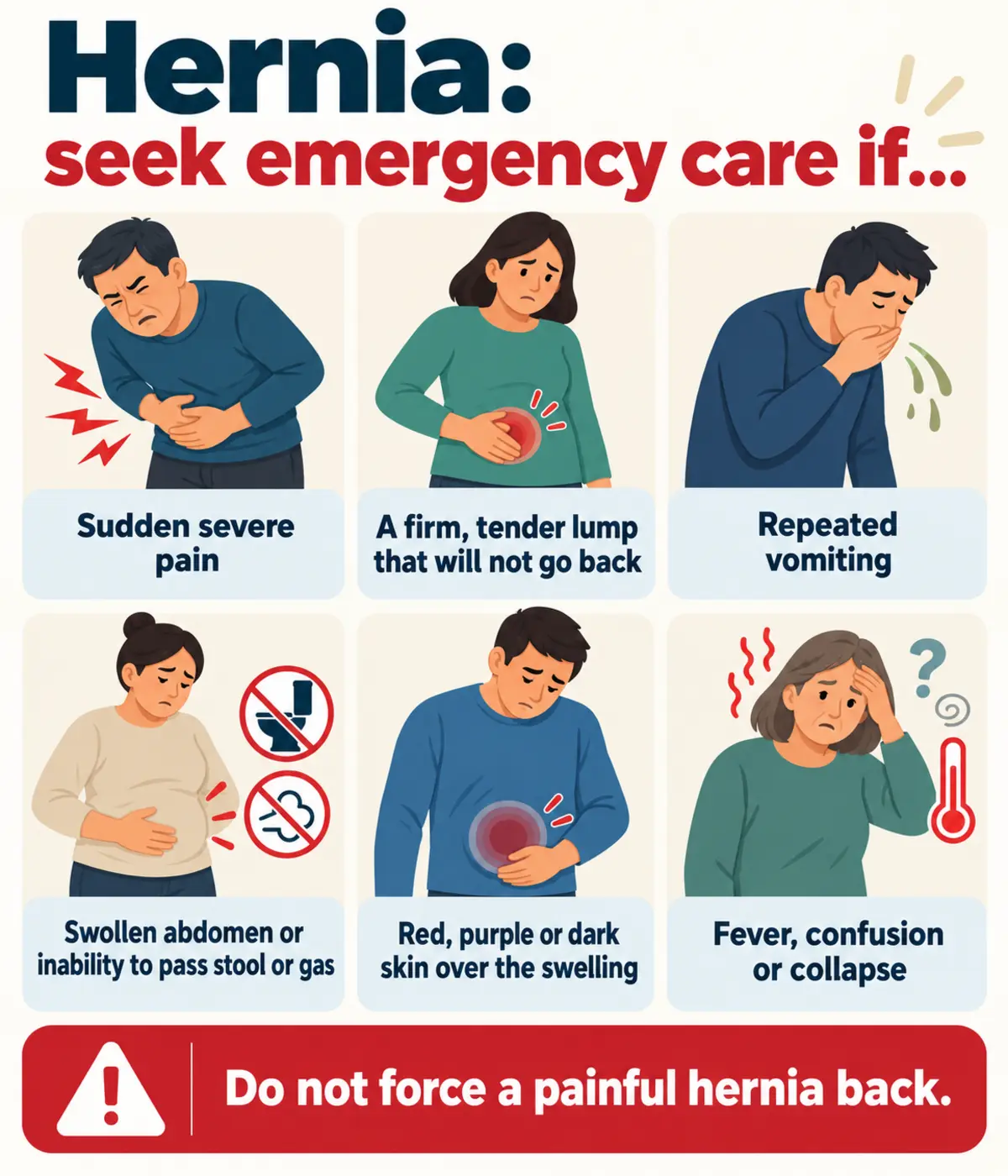
Emergency surgery may be necessary when bowel or other tissue becomes trapped and loses its blood supply. Sudden severe pain, a firm irreducible lump, vomiting, abdominal swelling, fever or skin colour change over the hernia requires urgent assessment.
Hernia warning signs that require urgent medical care
Seek emergency medical assessment when a known or suspected hernia is accompanied by:
Do not force a painful hernia back into the abdomen. Do not eat, drink or take someone else's medicine while delaying emergency assessment if obstruction or strangulation is possible.
What is a hernia?
The abdominal wall is made of layers of muscle and connective tissue. A weakness or opening can allow fat, bowel or another internal structure to protrude. The swelling may reduce when a person lies down or with gentle pressure, but it can reappear during coughing, lifting or straining.
Hernias are not simply “muscle swelling.” A surgeon needs to confirm the diagnosis and determine what is protruding, where the weakness lies and whether urgent treatment is required.
Common types of hernia
This article focuses mainly on adult groin and abdominal-wall hernias. Hernias in babies and children follow different clinical pathways and should be assessed by an appropriately qualified paediatric surgical team.
What symptoms can a hernia cause?
Symptoms may include:
- A visible or palpable lump in the groin, navel or abdominal wall
- A swelling that becomes more obvious while standing, coughing or straining
- Aching, burning, heaviness or a dragging sensation
- Discomfort during lifting, exercise or prolonged standing
- Pain while coughing, passing stool or urinating
- A feeling of weakness or pressure in the affected area
- Swelling extending towards the scrotum in some inguinal hernias
Not every groin or abdominal lump is a hernia. Enlarged lymph nodes, cysts, lipomas, muscle injuries, vascular conditions and other problems can appear similar. Examination matters before treatment is planned.
How is a hernia diagnosed?
Many hernias can be diagnosed through history and physical examination. The surgeon may examine the patient while standing and lying down and may ask the patient to cough or strain gently.
Imaging is not necessary for every obvious hernia. Ultrasound, CT or another scan may be advised when:
- The diagnosis is uncertain
- The swelling is not easily seen during examination
- An incisional, recurrent or complex hernia is suspected
- Another cause of pain or swelling must be excluded
- Emergency complications are being assessed
- The surgeon needs more anatomical information for planning
A scan should support clinical judgement rather than replace examination.
Can a hernia heal without surgery?
An adult abdominal-wall or groin hernia usually does not close permanently on its own. Medicines may relieve pain, constipation, cough or reflux, but they do not repair the opening in the abdominal wall.
Watchful waiting may be appropriate for selected adults with an asymptomatic or minimally symptomatic reducible inguinal hernia, particularly when the risk of surgery currently outweighs the benefit. It should include education about warning signs and planned review rather than indefinite neglect.
Watchful waiting is not suitable for everyone. Symptomatic hernias, femoral hernias, hernias that are difficult to reduce, and hernias with obstruction or strangulation need more urgent surgical consideration. Recommendations also differ for women, children, pregnancy and patients with major medical conditions.
Do hernia belts or trusses cure a hernia?
No. A belt or truss does not close the defect. It may provide temporary support for a selected patient who is not currently undergoing surgery, but it can fit poorly, cause skin problems, mask progression or give false reassurance.
Do not use a tight belt over a painful or irreducible swelling. A device should be considered only after diagnosis and professional advice.
When is planned hernia surgery usually considered?
Planned repair allows time for evaluation, discussion of the surgical approach and improvement of modifiable risks. A surgeon may recommend elective repair when symptoms are affecting quality of life, the hernia is enlarging, complications are becoming more likely or observation no longer suits the patient.
The assessment considers:
- Hernia type, size and location
- Whether it is reducible
- Pain pattern and effect on daily activity
- Previous abdominal operations or hernia repair
- Obesity, smoking, diabetes, chronic cough or constipation
- Heart, lung, kidney and other medical conditions
- Medicines, including blood thinners
- Occupation, lifting requirements and caregiving responsibilities
- Patient preferences after informed counselling
Seeing a surgeon does not commit a patient to surgery. It creates an opportunity to confirm the diagnosis and compare observation with repair.
What is the difference between open and laparoscopic hernia repair?
Hernia repair returns the protruding tissue to the correct position and strengthens the weak area. The operation may be open or laparoscopic, often called keyhole surgery.
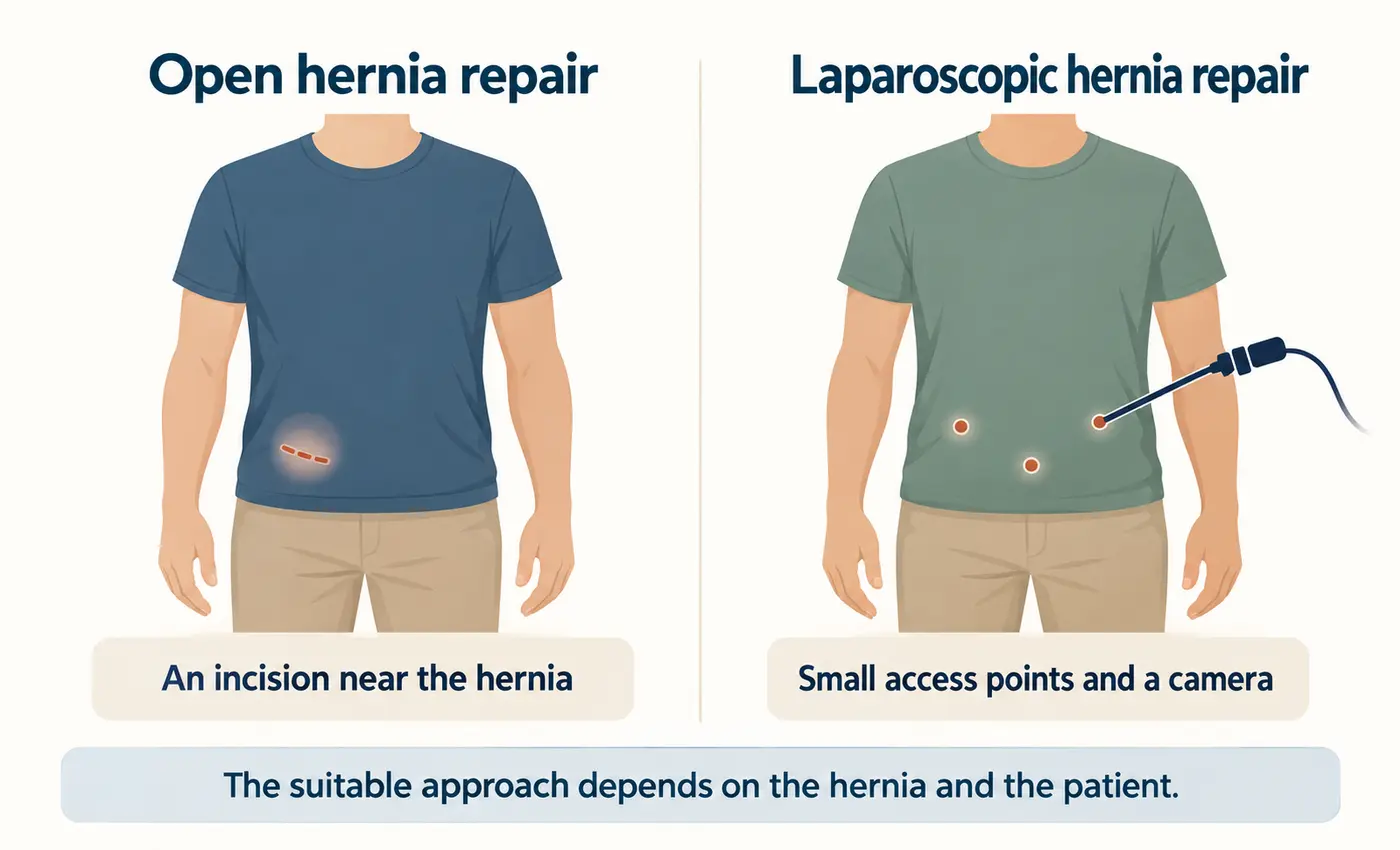
Neither approach is automatically better for every person. The decision depends on the hernia type, whether it is on one or both sides, previous repair, surgical history, anaesthesia fitness, surgeon expertise, available equipment and patient priorities.
Laparoscopic surgery should not be advertised as “no-cut surgery.” It uses small incisions and still carries risks, requires anaesthesia and needs recovery.
Is mesh always used in hernia surgery?
Mesh is commonly used in many adult hernia repairs because it reinforces the weakened area and can reduce recurrence in suitable cases. However, “mesh repair” is not one identical operation. Mesh type, size, position and fixation vary, and selected circumstances may call for a tissue repair without mesh.
The surgeon should explain:
- Why mesh is or is not recommended
- The proposed repair technique
- Alternatives that are reasonable for the individual patient
- Risks of infection, seroma, chronic pain and recurrence
- How prior surgery or contamination affects the plan
- Which questions or symptoms require follow-up
Do not market a mesh brand as proof of a superior result. Implant choice should follow clinical need, regulatory requirements and hospital procurement standards.
What are the possible risks of hernia repair?
Most patients recover without a major complication, but no operation is risk-free. Possible problems can include:
- Bleeding or haematoma
- Wound or mesh infection
- Fluid collection or seroma
- Temporary swelling or bruising
- Urinary retention
- Injury to bowel, blood vessels, nerves or nearby structures
- Numbness or persistent pain
- Blood clots or anaesthesia-related complications
- Recurrence of the hernia
- Need for another procedure
The likelihood and importance of each risk vary with the type of hernia, operation, urgency, patient health and previous surgery. Consent should address the patient's individual situation rather than use only a generic list.
How should a patient prepare for hernia surgery?
Preparation may include blood tests, anaesthesia assessment and review of medical conditions. Patients may be advised to:
- Stop smoking
- Improve diabetes and blood-pressure control
- Treat a persistent cough
- Address constipation and straining
- Work towards medically appropriate weight reduction
- Review blood-thinning medicines with the treating clinician
- Arrange help at home and transport after discharge
- Follow fasting and admission instructions exactly
Never stop aspirin, anticoagulants or another prescribed medicine without instructions from the treating doctor.
What is recovery after hernia surgery like?
Recovery depends on the hernia, type of repair, anaesthesia, patient health and the physical demands of work. Early walking is usually encouraged when medically safe. Pain relief, wound care and gradual return to activity should follow the treating team's plan.
Patients should receive clear instructions about wound care and bathing, medicines and constipation prevention, lifting, driving, work and exercise, diet and hydration, follow-up appointments, and warning signs that need urgent review.
Seek medical advice for fever, worsening pain, repeated vomiting, increasing abdominal swelling, inability to pass urine, persistent bleeding, wound discharge, breathlessness or a new painful lump. Avoid comparing recovery day by day with another patient because the operation and individual risks may differ.
Can a hernia come back after surgery?
Yes, recurrence is possible after any repair. Risk can be influenced by hernia type and size, tissue quality, previous operations, surgical technique, infection, smoking, obesity, poorly controlled diabetes, chronic cough, constipation and heavy strain during recovery.
Patients can support recovery by following activity instructions, attending follow-up, avoiding tobacco, managing weight and treating conditions that repeatedly increase abdominal pressure. These measures reduce avoidable risk but cannot guarantee that a hernia will never recur.
How should you choose a hernia surgeon or hospital in Ranchi
People frequently search for the “best hernia surgeon in Ranchi,” but no surgeon or technique is best for every patient. A safer decision uses transparent and verifiable information. Ask:
- Is the diagnosis and hernia type clearly explained?
- Are observation and surgery both discussed when appropriate?
- Why is open or laparoscopic repair recommended for this patient?
- Is mesh planned, and what are the alternatives and risks?
- Are anaesthesia, diagnostic and inpatient services available?
- Is emergency surgical assessment available if the hernia becomes trapped?
- What pain-control, infection-prevention and follow-up plan is used?
- What activity restrictions are expected for the patient's actual work?
- What is included in the written estimate?
- Who should the patient contact if symptoms worsen after discharge?
Avoid choosing solely from a fixed price, “scarless,” “painless,” “permanent cure,” “100% success” or “same-day recovery” advertisement.
Hernia consultation at Hopewell Hospital, Ranchi
Hopewell Hospital's service profile includes General, GI and Laparoscopic Surgery, led by Dr Shahbaz Alam Khan. Patients with a suspected groin, umbilical, incisional or other abdominal-wall hernia can contact the hospital for clinical evaluation and treatment planning.
The surgeon will determine whether observation, planned repair or urgent treatment is appropriate. To discuss a hernia, view Hopewell's doctors, book a surgical consultation or contact Hopewell Hospital.
If a hernia becomes suddenly painful, firm, irreducible or is associated with vomiting, abdominal swelling, fever, confusion or skin colour change, seek emergency medical care. Do not wait for a routine online appointment response.
Hopewell Hospital is located at New Hopewell Hospital, Hazari Baug Road, Tharpakna, Ranchi, Jharkhand 834001.
Final answer: when does a hernia need surgery?
Not every hernia needs immediate surgery, but every new or changing lump deserves medical assessment because an adult hernia rarely closes on its own. Repair becomes more urgent when the hernia is enlarging, painful, difficult to reduce or affecting daily life, and it becomes an emergency when tissue becomes trapped — signalled by sudden severe pain, a firm irreducible lump, vomiting, abdominal swelling, fever or skin colour change.
Have questions about this condition?
Speak with the Hopewell Hospital team for a personalised assessment and treatment plan.
Frequently asked questions
Does every hernia need immediate surgery?
No. Selected asymptomatic or minimally symptomatic reducible hernias may be observed with medical advice. Symptomatic, enlarging, femoral, irreducible or complicated hernias generally need more active surgical consideration.
Can exercise make a hernia worse?
Straining may make a bulge or discomfort more noticeable. Patients should avoid activities that clearly provoke pain until assessed. A clinician can advise safe movement and work restrictions based on the individual hernia.
Can medicine cure a hernia?
No medicine repairs an adult abdominal-wall defect. Medicines may treat associated pain, constipation, cough or reflux, but definitive repair of a groin or abdominal-wall hernia is surgical.
What does a reducible hernia mean?
A reducible hernia becomes smaller or goes back when lying down or with gentle pressure. A lump that was reducible but becomes painful, firm and irreducible requires urgent medical assessment.
Is every painful groin lump a hernia?
No. Lymph nodes, cysts, muscle injuries and vascular or other conditions can cause a groin lump. Examination and selected imaging help confirm the cause.
Is laparoscopic hernia surgery better than open surgery?
Not for every patient. Each approach has advantages and limitations. Hernia type, previous repair, both-side disease, anaesthesia fitness, surgeon experience and patient priorities influence the choice.
Will mesh cause problems?
Mesh is widely used and most patients do not develop a serious mesh complication. Infection, pain, fluid collection and recurrence can occur. The surgeon should explain why mesh is recommended and the alternatives for the individual case.
How long will recovery take?
Recovery varies by hernia, procedure, health and job demands. Many patients begin walking early, but return to driving, lifting, work and exercise should follow personalised instructions rather than a fixed internet timeline.
Can a hernia return after surgery?
Yes. Recurrence can occur even after an appropriate repair. Smoking, obesity, infection, diabetes, chronic cough, constipation, hernia complexity and previous surgery can affect risk.
Where can I consult a hernia surgeon in Ranchi?
Patients can use Hopewell's appointment page for a routine surgical consultation. Sudden severe symptoms require emergency assessment rather than waiting for an appointment.
Medical disclaimer
This article provides general education and does not diagnose a hernia or replace examination by a qualified clinician. A suddenly painful or irreducible lump, vomiting, abdominal swelling, fever, skin discolouration, confusion or collapse requires urgent medical assessment.